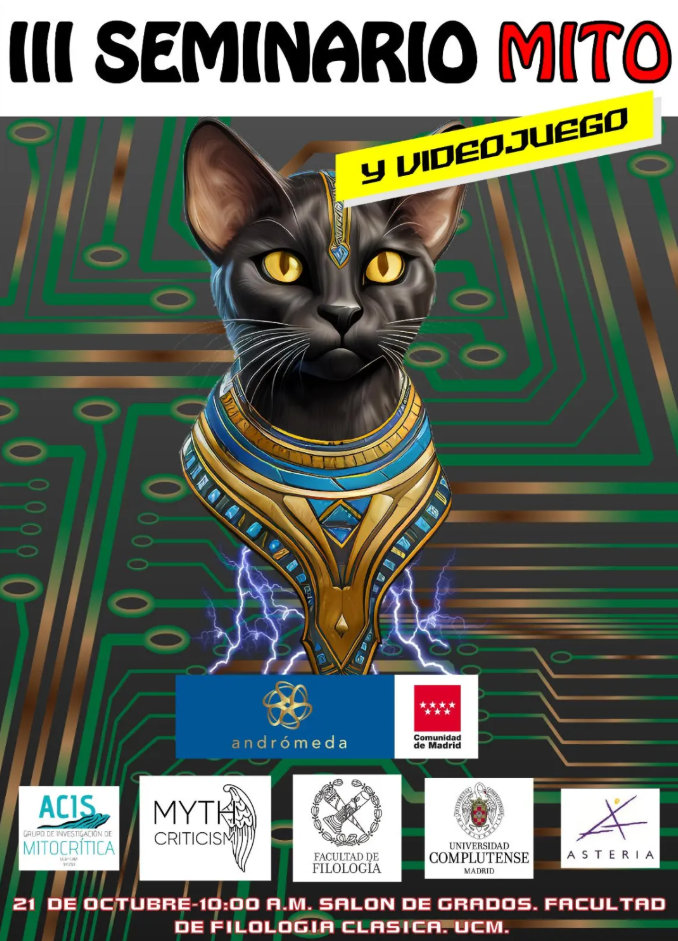
On the 21st of October 2025, was held the 3 rd Seminar “Myth and Video Games”, embedded in the activities of Proyecto Andrómeda (Ref.: PHS-2024/PH-HUM-76). As in previous editions of the seminar, it counted with the collaboration of Asteria, Association of Myth Criticism and Complutense University of Madrid. On this occasion, the seminar was held only via a Discord server, which made the participation of speakers and attendees easier.
As in previous editions, the event included presentations by specialists with a long career in the field of game studies, as well as academic researchers who have just begun to explore it. This blend contributed to a wider diversity of perspectives and approaches, favoring an enriching environment for dialogue and exchanging of ideas. The talks given offered a notorious thematical richness, addressing various aspects of myths and myth criticism in the context of ludic multimedia. Works ranging from contemporary videogames to emblematic titles from the nineties were analyzed, including productions with a big budget (triple-A) and proposals from the indie field. This variety allowed for a broader vision of the potential of video games as an object of study within myth criticism and the contemporary reception of myth.
Next, we present a summary of each speech, pairing with the main proposals carried out by the speakers:
Rebeca. E. Campos – Digital Desolation: The Literary Legacy of Eliot’s Wasteland and Ishiguro’s Dystopia in Cyberpunk 2077
This study analyzes how the video game “Cyberpunk 2077” extends and reformulates the modern wasteland literary tradition, drawing on the spiritual desolation of T. S. Eliot’s “The Waste Land” and the biopolitical dystopia of Kazuo Ishiguro’s “Never Let Me Go”. Through an interdisciplinary approach combining literary and game studies, it examines how the game transfers fragmentation, alienation, and control of the body to the digital space, inviting the player to a firsthand experience of what modern and contemporary literature could only represent. In this way, it proposes a reading of the video game as both heir and expansion of literary narrative, where the ruins of modernity are transformed into an interactive and aesthetic experience of the 21st century.
Brennan White – Modern Myths Require Modern Solutions: Myths in video games created to explore 21st-century philosophical issues
Brennan White’s talk focused on myth’s nature as an element that furthers the experience in video games. The blend of myth, symbols and culture, all of them created within the game itself, offers the player new ways to address contemporary philosophical issues, including ethics, mental health or reality. Just as the great philosophical novels of the 20th century used symbols and myths to explore their coetaneous issues, the new medium of video games continues that tradition, but offering a much more direct and interactive experience.
Ruth García and Begoña Cadiñanos – Hades II: Witchcraft and reinterpretations of mythical feminine figures.
Ruth García and Begoña Cadiñanos’s talk addresses two fundamental themes present in the video game “Hades II”. First, they analyze the treatment of sorcery in the game, both in relation to the protagonist and other mythical figures who possess magical powers. The analysis reveals how the game draws on classical sources while introducing subtle and contemporary references that allow it to connect with a modern audience without sacrificing depth or mythological rigor. Second, they examine the representation of various mythical female figures, traditionally associated with negative connotations due to their connection to magic or their role as deities, as is the case with Eris and Nemesis. The talk highlights how “Hades II” offers a renewed and more positive vision of these characters, contributing to a critical and enriching reinterpretation of classical myths from a contemporary perspective.
María Flores – Playing with death: Hades’ conception in “Spiritfarer”
“Spiritfarer” is an endearing and cozy indie video game about managing death. In it, the players play the role of Stella, a young woman to whom Charon, the ferryman from the Beyond in charge of transporting souls, hands over the baton. Stella’s main function as a new guide to spirits or souls is, therefore, to help them make their last journey. “Spiritfarer” presents death and the afterlife from a very particular perspective, with ideas that come from different cultures and religions. However, among them, those from Ancient Greece are the main inspirations for the game’s approach, according to its creators. This culture, the cradle of our Western civilization, has been and continues to be a great source of inspiration at a creative and narrative level in different media, and video games are no exception. For this reason, the main goal of the talk has been to analyze some of the most significant ideas that “Spiritfarer” takes from Greece. We have seen how he reworks them, noting the similarities and differences that exist with respect to the original sources in each case. Through this examination, we have been able to observe that, although there seems to be a series of reworkings that creators have made consciously, others seem to go beyond their own consciousness, since there are elements that, with the passing of time and by different means, have been assimilated into the collective cultural imaginary. At the same time, this analysis has been expected to contribute to a greater understanding of how video games serve very effectively as a vehicle for cultural transmission.
Sergio López – Between devotion and profanity: the religious imaginary of “Blasphemus”
Sergio López introduced us to the universe of “Blasphemous”, set in the fictional world of Custodia, characterized by its visual and symbolic baroque style. Its analysis delved in the representation of a corrupted religious hierarchy and distanced from its original spiritual message, in contrast to a piety society who, despite its contradictions, preserves the original of what this said hierarchy should represent. The talk highlighted how the video game enunciates a critic to ecclesiastical power through a esthetic setting deeply influenced by sacred art and Spanish Catholicism iconography.
Jaime Segura –When Odin Meets Azeroth: the Reception of Norse Myth in World of Warcraft
El trabajo gira en torno a la recepción de mitos nórdicos en el mundo de Azeroth, del universo World of Warcraft, y cómo su adaptación, así como los factores que condicionan su forma y elección, nos pueden dar información valiosa acerca de la supervivencia del mito en la sociedad postmoderna. Entre Lokens y Val’kyrs, la presentación cubre las razones de elección de distintos mitos, la búsqueda de referentes culturales relevantes para un público principalmente occidentalizado, la adaptación de símbolos canónicos a mecánicas de juego para favorecer la inclusión del personaje mítico, y lo que podemos extraer de todos estos usos. El mito, que es efectivamente recontado, pierde algunos de sus aspectos definitorios necesarios, y plantea preguntas acerca de los mitos de creación propia de World of Warcraft y del papel del mito en sí mismo en la cultura contemporánea.
The paper revolves around the reception of Nordic myths in the world of Azeroth, from the universe World of Warcraft, and how its adaptation (as well as the elements that determine its shape and choice) can give us valuable information about myth survival in postmodern society. Among Lokens and Val’kyrs, the talk addresses the reasons behind the choices of different myths, the adaptation of canonical symbols into game mechanics to favor the insertion of mythical figures, and what can we deduce about all these uses. The myth, which is effectively retold, loses some of its necessary defining aspects, and raises questions about World of Warcraft’s self-created myths and the role of the myth itself in contemporary culture.
Pablo Martín – The shine of Damnation
“The Shine of Damnation” explores the contrast between the narrative structure of videogames until the end of the 1990s and contemporary narratives. This narrative shift is articulated in a transit between the classic forms of mythological narrative, where the activities of the characters contrast and are limited to a world that is explored. On the contrary, in current narratives, the focus is on the concrete subject, protagonist and defining of the world around him instead of a universe with limits. Part of the failure of many of these individualized narratives stems from their inability to articulate a transcendence narrative, which is an intrinsic element of traditional mythological narrative. “The Brightness of Damnation” explores the contrast in the narrative structure of video games until the late 90s compared to current narratives. This narrative shift is articulated in a transit between the classic forms of mythological narrative, where the activities of the characters contrast and are limited to a world that is explored. On the contrary, in current narratives, the focus is on the concrete subject, protagonist and defining of the world around him instead of a universe with limits. Part of the failure of many of these individualized narratives stems from their inability to articulate a transcendence narrative, which is an intrinsic element of traditional mythological narrative.